
Adding Battery Storage
 •July 2, 2020•9 Minutes
Batteries can solve, or at least reduce, the main problem of renewable energy: constantly providing uninterrupted power supply.
Battery storage can be utilised for the household or utility-scale applications. Most of Europe and the UK rely heavily on energy imports and at the same time in the UK, we have massive potential for wind, wave, hydropower and solar energy. A prime example being Scotland, committed to a net-zero carbon emission by 2045, proactive decisions have been made that have seen renewables making up ¾ of electrical generation with the aim of all electrical generation coming from renewables. As noted, the common concern is the reliability of the power supply so this is where battery storage comes in. Increasing the use of renewable energy with the added security of battery backup allows energy imports to be reduced, with clear benefits for national energy independence and security. Decarbonisation of the energy mix and reduction of overall CO2 emissions are other clear, positive outcomes of increased use of battery storage.
Energy independence is fast becoming attractive and achievable for many end-users, both domestic and commercial. Whether someone has solar already and simply want to add battery storage or want to have battery storage installed along with their solar PV installation – CCL Components have lots of different options available today.
![]() What types of battery are available?
What types of battery are available?
Lithium-ion batteries
• Increasingly common in domestic grid-connected solar PV storage systems
• Require an integrated controller, that manages charge/discharge
• More efficient
• Can discharge the more stored energy
• Longer expected lifetime
Lead-acid batteries
• Typically used for off-grid properties where more storage is required
• Heavier and larger
• Need good charging and discharging routine to maintain battery health
• Less efficient
• Shorter expected lifetime
![]() Things to consider when deciding on a battery storage system
Things to consider when deciding on a battery storage system
What is the load profile?
The load profile is how much electricity is used and when.
If people are home during the day then this would mean that the majority, if not all the PV generated electricity, is used as it is generated. Meaning there is no surplus solar-generated electricity to store in a battery system.
If there are energy-intensive appliances set to run during the day or if some electricity is diverted to an immersion heater to heat hot water, it will mean little to no solar electricity can be stored in a battery system.

Typically, an average home uses around 12.5kWh per day or 4,500kWhrs per annum. Most homes that have existing solar PV have from 2.0kWp to 4kWp installed which can generate anything from 1800kWhrs to 4000kWhrs per annum which means there is only so much generated energy you can store.
Information on how much solar is generated from a system at different times of the day/year will be paramount in deciding to install battery storage (unless it is a new-build).
The DECC (Department of Energy and Climate Change) which has changed to be part of the BEIS (Department for Business, Energy & Industrial Strategy), had stated that consumers typically only use between 20% and 30% of rooftop solar energy. With intelligent system sizing and integrated battery storage, the level of self-consumption can be brought up to 70% - 80% and the levels of imported energy to a bare minimum.
Feed-in tariff (FIT)
Applications for the feed-in tariff scheme ended on the 31/3/19. AC coupled / retro-fits will have no effect on FIT income. If an inverter is being replaced it should be a like for like and to be sure – your DNO should be contacted.
DC-coupled battery systems can suffer from reduced FIT payments. This is because the electricity going direct to the battery isn’t registered by a generation meter but only does so when the electricity is discharged by the batteries. ALL batteries lose energy in the charge-discharge cycle, meaning the original total solar-generated power will be lost in the process.
Smart Export Guarantee (SEG)
The government introduced the Smart Export Guarantee 1/1/2020. Energy companies with more than 150,000 customers will be required to introduce an export tariff for solar and wind turbine systems with capacities of up to 5MW. The SEG differs from the FIT as it is now the energy supplier’s responsibility and not the government's, to pay the tariff for exporting electricity to the grid. It should be noted that a value has not been decided per kW exported back to the grid, it previously being just 5 pence from the government, the energy suppliers have free reign in deciding the new amount. The only stipulation is that the value is to not be lower than 0.1p p/kWh
How difficult is it to add a backup battery to your solar panel system?
The level of difficulty associated with adding a battery depends on whether your solar panel system was designed to add energy storage later on or not.
If you have a 'storage ready' solar system, you already have an inverter that can easily integrate a battery into your solar panel system (commonly known as having a ‘Hybrid Inverter’). A battery is relatively simple to install, and the installation process won’t require much additional equipment.
If your solar panel system was not originally designed with the ability to add storage later, the installation will be slightly more complicated. In this scenario, you have two options: an “AC coupled” solution or an inverter replacement.
AC coupled battery storage solution
If you choose an alternating current (AC) coupled solution, your battery is installed with a separate inverter that is integrated into your home’s energy system.
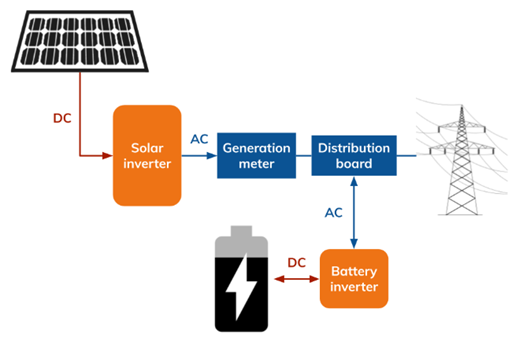
If you install an AC coupled solution, you can keep your solar system’s existing inverter, which can save money upfront. You can also be more flexible in terms of the size of your battery, relative to your solar panel system.
The Solis RAI coupled with some Pylontech batteries is a prime example of a system that we can offer in this situation. There are other configurations so please get in touch to find out more. Details at the bottom of this post.
Inverter replacement/DC-coupled solution![]()
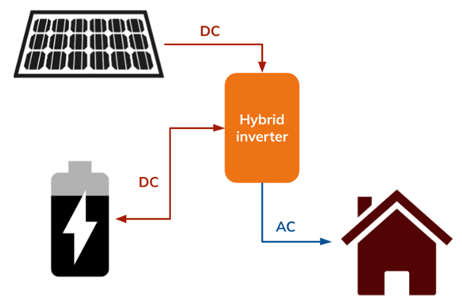
The alternative to an AC coupled solution is to replace your existing solar inverter with one that works with your battery. String inverters need to be replaced every 10/15 years, so if you have a solar panel system that’s at least five years old, you may want to think about swapping your existing inverter for an all-in-one option like the Fronius GEN24 Hybrid, SolarEdge StorEdge, SonnenBatterie, SMA SunnyBoy & SunnyIsland ranges or the Solis RHI.
The primary benefit of a DC-coupled solution is that your system will be more efficient – it will lose less of the energy your solar panels produce during the conversion process.
Ask about our grid-tied and off-grid battery solutions today, whether it be for a new install or upgrading your existing system – we have a solution for you. Contact your account manager at CCL today or simply call into our sales team on:
T: +44 (0) 1355 599 990
E: sales@blog.cclcomponents.com
